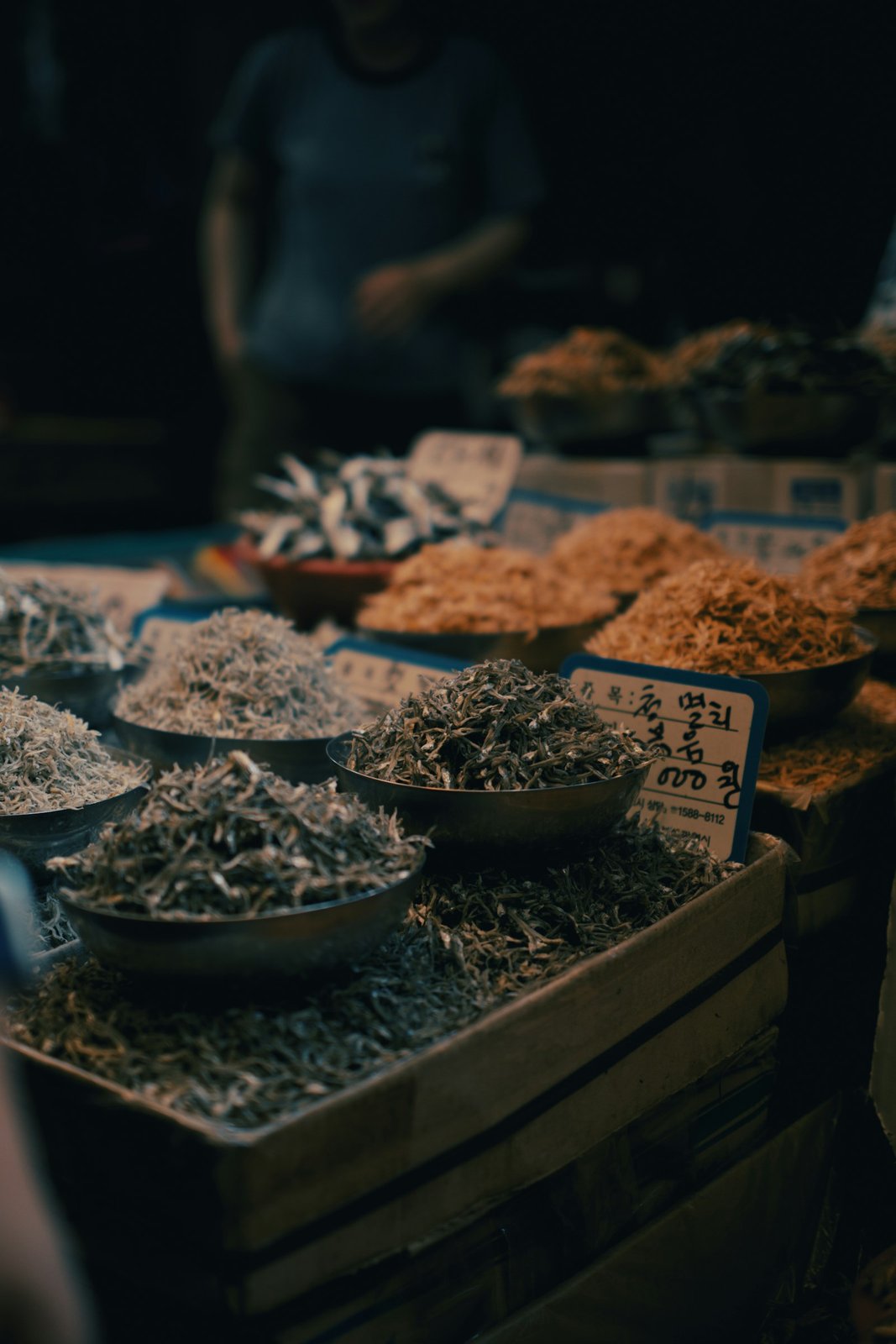
The stall-keeper is weighing a bag of dried anchovies when a regular walks up. 「밥 먹었나?」 she asks him, without looking up from the scale. A minute later a younger woman stops to buy squid, and the question changes shape: 「뭐 먹었노?」 To a student who learnt Korean from a Seoul textbook, both sound like small mistakes. They are not. They are two halves of one rule in the Gyeongsang dialect of the south-east, and the first one only wants a yes or a no. The scene is ours, and so are the two sentences: we built them from the dictionary entries, not from a drama.
We, the Haeyo teachers, should say where we stand. We teach the standard language, because that is what textbooks, exams and most offices use, and we think a learner should own it first. But this issue is about life outside Seoul, and outside Seoul people do not talk like the textbook. If you are moving to Busan, Daejeon or Jeju, you will hear something else in the market, on the bus and at the dinner table. This article explains what that something is, using only forms we could find in a dictionary or an official reference.
What 'standard' means
Korea's Standard Language Rules begin with one sentence: the standard language is, in principle, 「교양 있는 사람들이 두루 쓰는 현대 서울말」, the modern Seoul speech that educated people widely use. The current notice dates from 28 March 2017. In other words, the standard is officially defined by one city. Every other variety is called a regional dialect, 지역 방언, or more casually 사투리.
What about TOPIK? TOPIK study books and past papers are written in the standard language. We looked for a line in the official test guidelines that says regional forms are excluded, and we did not find one, so we will not tell you TOPIK is 'standard only' as a rule. In practice, study the standard for the exam, and treat dialect as a listening skill for daily life.
What Koreans think of their dialects
The National Institute of the Korean Language (NIKL) runs a National Survey of Language Awareness every five years. In the 2025 round (5,000 people aged 20 to 69, announced on 27 January 2026), 59.2% said regional dialects should be kept, 8.3 points more than in 2020. And 47.7% were positive about recognising regional dialects as additional standard forms. Feelings, in short, are warming.
Use is another matter. A regional newspaper, reporting on the same survey in October 2026, said 21.4% named the Gyeongsang dialect as the speech they use most (22.5% in 2020). Among people in their twenties, 68.2% said they mostly use the standard and 16% the Gyeongsang dialect. Asked about attitude, 25.9% said they switch depending on time and place, and 23.7% said they speak the standard and avoid dialect where possible. We could not match these figures against the NIKL report itself.
For 2020, a wiki summary of the report, which we could not check against the original, gives 50.9% in favour of keeping dialects and only 9.7% against. It also says 86.1% of dialect speakers felt positive about their own dialect, and 79.9% of standard speakers felt a sense of closeness when talking to someone in dialect.
The numbers, with their labels
- Say regional dialects should be kept (NIKL survey, 2025)
- 59.2%, up 8.3 points on 2020
- Positive about dialects as additional standard forms (NIKL survey, 2025)
- 47.7%
- Name Gyeongsang dialect as the speech they use most (2025 survey, press report)
- 21.4% (22.5% in 2020)
- People in their twenties: mostly standard / mostly Gyeongsang (2025 survey, press report)
- 68.2% / 16%
- Switch between standard and dialect by situation (2025 survey, press report)
- 25.9%
- UNESCO status of the Jeju language (December 2010)
- Critically endangered, stage 4 of 5
- Jeju language ordinance / preservation society founded
- 2007 / 2008
- Current Standard Language Rules notice (Ministry of Culture)
- 28 March 2017
Rows marked unverified come from a newspaper report that we could not match to the NIKL tables.
Gyeongsang: Busan and the south-east
Start with the question rule from the market. In plain speech, the Urimalsaem dictionary lists 「-나」 as a Gyeongsang question ending for questions with no question word, and 「-노」 for questions that contain one, such as 뭐, 어디 or 왜. So 「밥 먹었나?」 means 'Did you eat?' and expects yes or no, while 「뭐 먹었노?」 means 'What did you eat?' Once you know this, a lot of Busan speech stops sounding like random noise.
Polite speech has its own endings. The dictionary gives 「-심더」 for '-습니다' (North Gyeongsang) and 「-ㅂ니꺼」 for '-ㅂ니까' (South Gyeongsang). Some everyday words you may hear: 「정구지」 for 부추 (garlic chives, also used in North Jeolla and Chungcheong), 「단디」 for 단단히 (firmly, properly), 「쪼매」 for 조금 (a little), 「억수로」 for 대단히 (very) and 「마카」 for 모두 (all). One warning: 「퍼뜩」 is often called a Busan word, but it is also a standard dictionary word, so do not use it as proof that someone is speaking dialect.
Then there is the music. Gyeongsang speech is famous for its rises and falls in pitch, and pitch can change meaning. We did not find an official source that we could open and cite for the details, so we will say only this: if a Busan sentence sounds angry to you, it probably is not. Listen to the shape of the whole phrase before you decide.
Chungcheong: Daejeon and the middle
The best-known Chungcheong feature is the sentence ending. The dictionary lists 「-슈」 for '-어요' (Chungcheong) and 「-어유」 for '-아요' (North Chungcheong). An NIKL magazine article from 2007 notes that television writers use the '-유' ending as the main marker of Chungcheong speech, and gives the example 「식구가 다 들에 갔대유」, standard 「식구들이 다 들에 갔대요」, 'The family have all gone to the fields, they say.'
A 1987 article in the same magazine adds some history: for a long time scholars grouped Chungcheong speech with the central dialects around Gyeonggi, and only from the 1960s did it begin to be treated as a dialect area of its own. You may also hear that 'Chungcheong people speak slowly'. That is a popular image. We found no study that measures it, so please do not repeat it as a fact.
Jeju: a language in danger
Jeju is different in kind. In December 2010 UNESCO listed the Jeju language as critically endangered, stage 4 on a five-stage scale, one step before extinct. Some articles say 2011, but a January 2011 report describes the decision as made 'last December'. You will see speaker numbers online; the ones we found came only from blogs, so we leave them out.
The greeting you will see on signs is 「혼저 옵서예」, 'Welcome' (standard 「어서 오십시오」), recorded in Jeju-language teaching material held by the National Library of Korea. Be careful with dictionaries here: Urimalsaem lists 「혼저」 only as a dialect form of 혼자 (alone) from Gangwon and South Chungcheong, not in the Jeju sense.
The endings are what make Jeju speech hard for newcomers. A research centre guide lists polite statement endings such as 「-ㅂ네다」, 「-ㅂ데다」 and 「-수다」, question endings such as 「-ㅂ네까」, 「-수강」 and 「-수꽈」, and command endings 「-(으)ㅂ서」 and 「-십서」. Urimalsaem confirms 「-우다」 for '-ㅂ니다' and 「-ㅂ서」 for '-ㅂ시오'. Words to know: 「하영」 (many, a lot), 「하르방」 (grandfather), 「할망」 (grandmother), 「지슬」 (potato) and 「맨도롱하다」 (pleasantly warm).
The same guide says Jeju long kept the old vowel 아래아 (ㆍ), but younger speakers now use a seven-vowel system in which it has merged with others. Jeju spelling also writes the past tense with 「-앗-/-엇-」. That is why the 2025 drama title 「폭싹 속았수다」, Jeju for roughly 'You have worked so hard', can be misread by Seoul eyes as 'completely cheated'. The island has tried to protect its language: an ordinance in 2007, a preservation society in 2008, and in 2016 a plan to add Jeju-language lines to culture and tourism signs.
If a Busan sentence sounds angry to you, it probably is not. Listen to the shape of the whole phrase before you decide.
Gyeongsang (around Busan)
Questions split: 「-나」 for yes/no, 「-노」 with a question word. Polite 「-심더」, 「-ㅂ니꺼」. Words: 단디, 쪼매, 억수로. Pitch can change meaning.
Chungcheong (around Daejeon)
Endings 「-슈」 and 「-어유」 where Seoul says '-어요/-아요'. The '-유' sound is the one people imitate. The 'slow speech' idea is an image, not a finding.
Jeju
Its own endings (「-수다」, 「-수꽈」, 「-ㅂ서」) and words (하영, 할망, 지슬). Listed by UNESCO as critically endangered in 2010. Signs may greet you with 「혼저 옵서예」.
| Standard | Region | Regional form |
|---|---|---|
| -습니다 | North Gyeongsang | -심더 |
| -ㅂ니까 | South Gyeongsang | -ㅂ니꺼 |
| -어요 | Chungcheong | -슈 |
| -아요 | North Chungcheong | -어유 |
| -ㅂ니다 | Jeju | -우다 |
| -ㅂ시오 | Jeju | -ㅂ서 |
Only forms we found in Urimalsaem. Many more exist; we left out anything we could not look up.
What this means for you
You do not need to speak a dialect. Nobody expects it, and a foreign student who suddenly says 「억수로」 may get a smile, usually a kind one. What helps is recognising the common forms, so that a question ending in 「-노」 or a shop sign in Jeju does not stop you.
Our advice, from the classroom rather than from data. First, when a word confuses you, search it in Urimalsaem: entries marked 「방언」 tell you the region and the standard word. Second, remember the survey figure: about a quarter of Koreans say they switch between standard and dialect depending on the situation, so if you ask politely, most people can move closer to the standard for you. 「천천히 다시 말씀해 주시겠어요?」 works everywhere. Third, train your ear with local radio and TV news and talk shows from the region, then go back to the market and listen again.
Busan, Daejeon and Jeju each get their own article in this issue, with costs, transport and the honest downsides. Read those for the practical side; read this one again in a month, when the market starts to make sense.