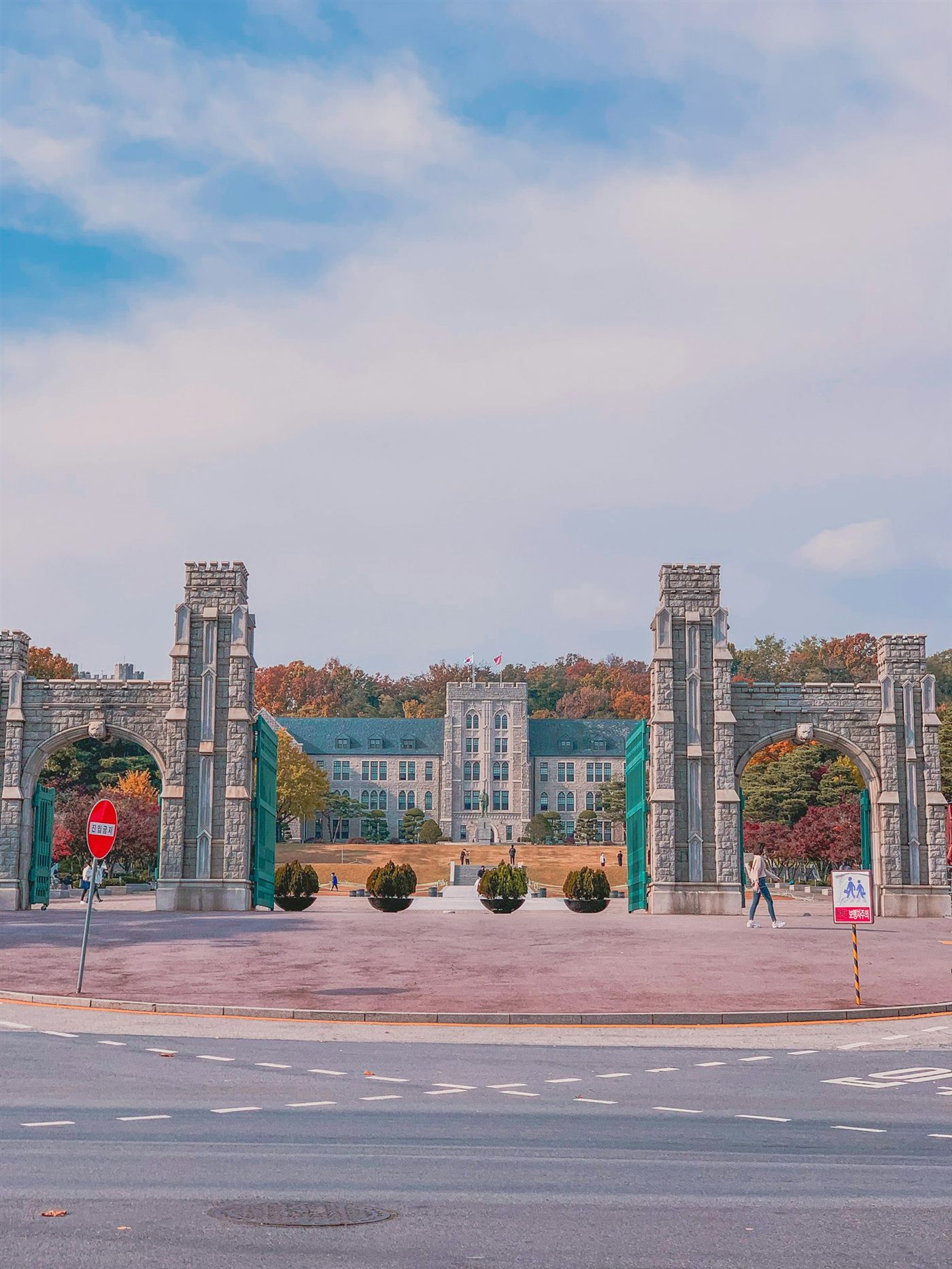
Nobody in this story is a real person. We built the day below from what we know of Seoul's university districts, and we mark every figure with where it came from. Where we could find no number, we say so and describe instead. Treat the hours as a plausible shape, not a timetable.
We, the Haeyo teachers, chose to write it as a day because that is how a neighbourhood actually reaches you. Not as a rent table, not as a ranking, but as a sequence of small errands in a language you are still learning. Each hour below ends with the Korean you would need to get through it.
08:30 — The walk in
Imagine a student who has just moved into a one-room flat a ten-minute walk from campus. The street at this hour belongs to people in a hurry: delivery scooters, coffee cups, backpacks, earbuds. Shutters are going up on the small restaurants that will feed the same crowd in three hours. The district exists because of this crowd, and it re-arranges itself around the academic day.
Why live this close? Part of the answer is money, and part is time. A survey by the property app Dabang of ten university areas in July 2026, for one-room flats of up to 33 square metres with a 10 million won deposit, put the average monthly rent at 625,000 won, up 7.7 percent on the year, with management fees averaging 84,000 won. The spread was wide: near Ewha the average was 767,000 won, near Chung-Ang 522,000 won.
Two cautions. These are advertised averages, not what every student pays, and your own deal will differ with the room, the deposit and the month. The same survey did not cover every campus, so do not read it as a league table of Seoul. We keep the neighbourhood-by-neighbourhood comparison for the cover story of this issue.
Useful Korean for the first walk: 「안녕하세요」 to the shop owner who will soon know your face, and 「이 근처에 학식 있어요?」 (is there a campus canteen near here?).
10:00 — The first lecture, and what a student pays for lunch
The first class lets out before noon, and the real question of the morning begins: where do we eat? The answer for most students is the 학식, the campus canteen. A 학식 is a tray meal at a price set far below the restaurants outside the gate, and it is the quiet anchor of a student budget.
Prices have been climbing. Korean media in February 2026 reported that Seoul National University moved its student-restaurant range from 3,000-6,000 won to 4,000-7,000 won, while holding a 1,000 won set meal; Hanyang's Seoul campus was reported rising from 3,600 to 4,200 won for some items, Sogang's second student hall from 4,800 to 5,500, and a Yonsei chicken-and-rice soup was cited at 5,300 won against about 10,000 won at a nearby restaurant. The dates of each rise differ between articles.
We did not find a citywide average 학식 price, so we will not give you one. What we can say is that you should expect roughly the 4,000-7,000 won range in the schools we cited, and that the gap to an outside restaurant is real. Check your own campus: the price and the menu are usually posted at the entrance or on the school app.
The cheapest hot meal near any campus is the one the university itself serves.
How do you order? Usually you pay at a kiosk or counter first, take a tray, and queue at the serving line. Some canteens use a ticket or card system you will meet on day one. If you are lost, point and say 「이거 주세요」 (please give me this), which is the single most useful sentence of your first month.
12:30 — Café hours, and the culture of studying out loud
After lunch, the café. Korean campus districts are dense with them, and many students treat a café as a second desk. There is even a word for it: 카공, short for 카페에서 공부하다, studying in a café. You will see laptops, textbooks, highlighters and one cup of coffee that has lasted three hours.
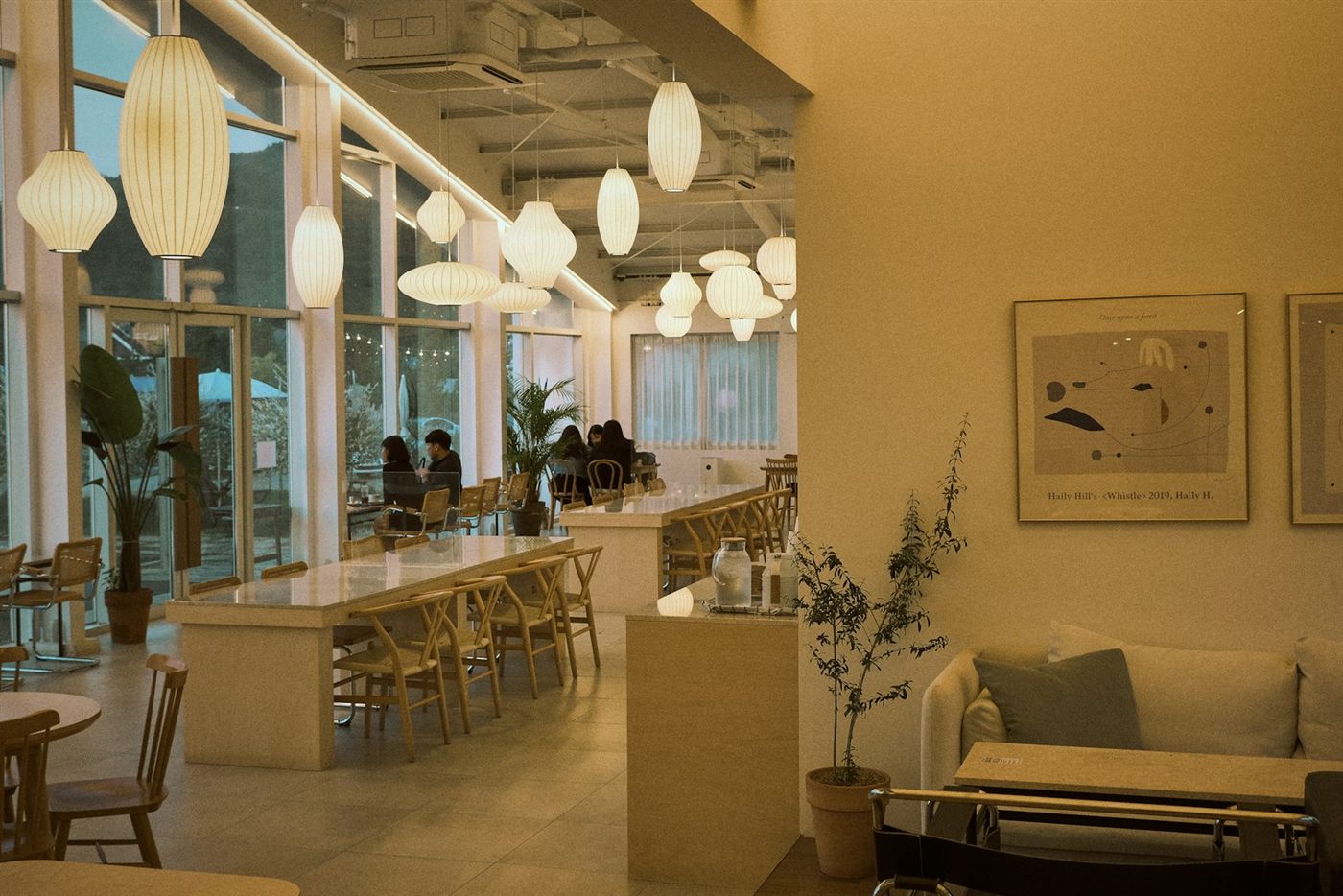
We have no hard statistic on how common 카공 is, and we found no reliable survey, so we describe it only as our own observation of how students use these spaces. The unwritten rules are the part worth knowing. Order something. Keep your voice low on calls. Do not spread across a table meant for four when the room is full. Some cafés now post signs about time limits or outlet use, and the sign beats any rule of ours.
You will also notice that you can often leave a laptop and a bag on a table to go to the counter or the bathroom. Many foreign students are startled by this. We would still suggest keeping your passport and wallet with you, because the habit is a custom and not a guarantee.
Korean to carry: 「아이스 아메리카노 한 잔 주세요」 (one iced Americano, please), 「와이파이 비밀번호가 뭐예요?」 (what is the wifi password?), and 「콘센트 써도 돼요?」 (may I use the outlet?).
15:00 — The library, quiet by design
In the afternoon the library takes over. University libraries in Korea are where the serious work happens: assigned seats, reading rooms, silent floors, group study rooms you book on an app. We could not source opening hours in this research round, and hours differ by school and by exam season, so we will not print any. Look at the library page of your own university before your first week.
A practical note for language-institute students: library and building passes may be separate from the main university's, so ask at the office rather than assuming the gate will open for you. The staff would rather answer the question than watch you stand outside.
A district is a set of rooms, and a student is a person who learns which room is for what.
Useful Korean: 「자리 있어요?」 (is this seat taken?) and, if you are the one who needs to apologise for noise, 「죄송합니다, 조용히 할게요」 (sorry, I will be quiet).
17:30 — 동아리, the clubs that make a big campus small
As classes end, notice boards and group chats fill up. A 동아리 is a student club: sports, music, volunteering, language exchange, photography, hiking, board games. For a newcomer, it is the quickest way to hear ordinary Korean from people your age, and it is how many friendships start.
A word of honesty. We did not find a source on club fees, recruitment seasons or how foreign students are treated, and these vary hugely between clubs and schools. Ask directly, ask early in the semester, and do not be discouraged if one club's chat goes quiet. Many universities also have an international office that can point you to exchange or buddy activities, which can be a gentler first step.
Korean for the club room: 「동아리에 들어가고 싶어요」 (I would like to join a club) and 「외국인도 가입할 수 있어요?」 (can foreigners join too?).
19:00 — Dinner, and the shape of a student district
Evening is when the district earns its name. The restaurants that were empty at 09:00 are full, and the choice is enormous. We have no sourced average dinner price, so we will describe the pattern rather than invent a number: set meals and one-dish plates are the student default, group meals are the treat, and the best value is usually one block away from the main street.
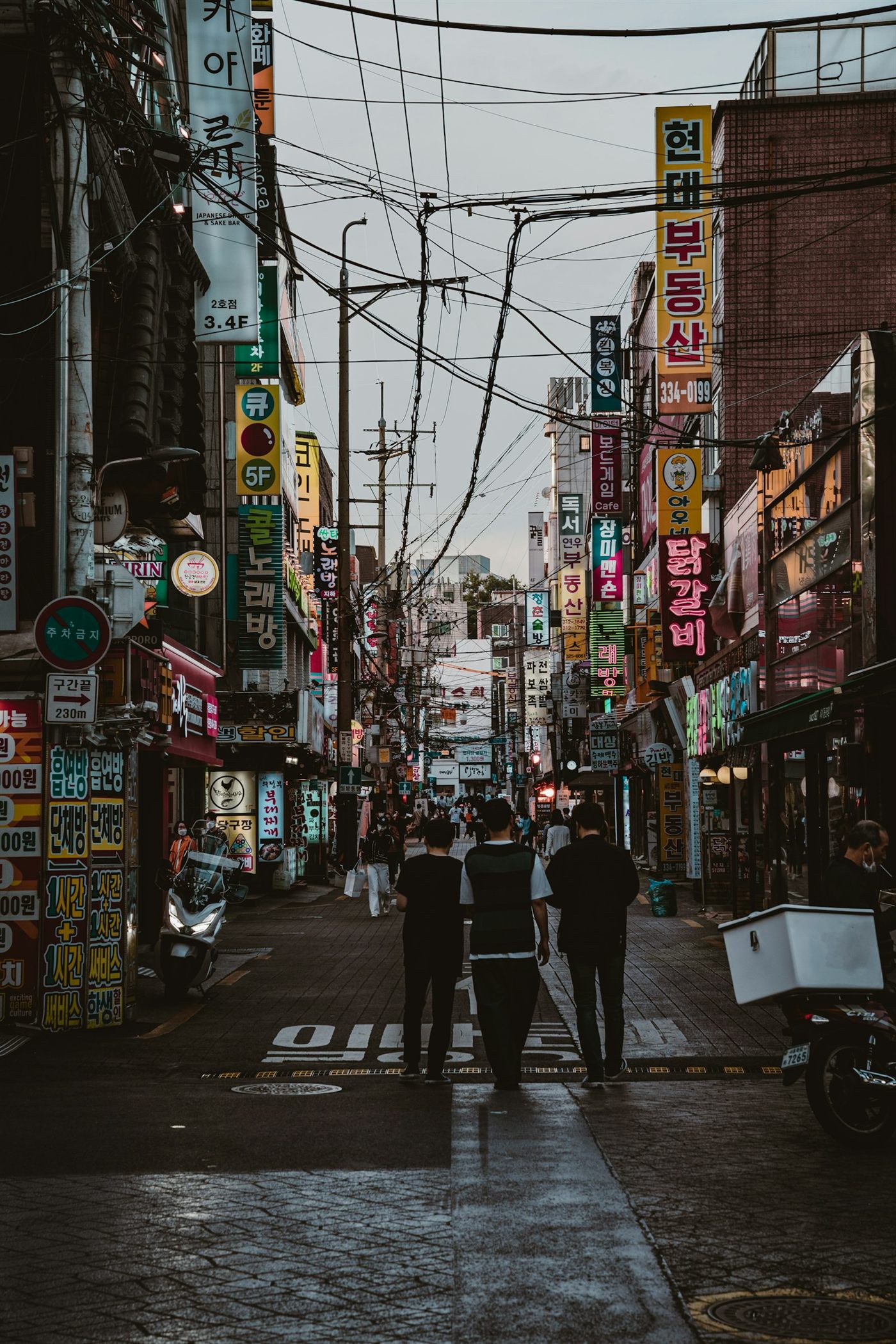
Something else shapes the neighbourhood too: the people who live alone. In 2024, 39.9 percent of Seoul households were single-person, the highest share among Korean regions, and in Gwanak-gu, the district around Seoul National University, the figure reached 62.6 percent, the highest among Seoul's districts. That is a quiet reason why so many small restaurants and shops are sized, priced and timed for one person.
21:30 — The convenience store
When the studying is done and the shops are shutting, there is still the convenience store, 편의점. It is the district's night kitchen, post office, printer and cash point. You can buy a triangle rice ball (삼각김밥), instant noodles, a drink, laundry detergent or a phone charger. Many stay open through the night, though hours differ by shop and we did not count them.

Foreign students often tell us the convenience store is the first place where Korean felt manageable: the products are visible, the price is on the shelf, and the exchange is short. You are usually asked only a few things: do you want a bag, do you want it heated, and are you paying by card?
Korean you will hear and can answer: 「봉투 필요하세요?」 (do you need a bag?) with 「네」 or 「아니요」, and 「데워 드릴까요?」 (shall I heat it?) with 「네, 데워 주세요」.
23:00 — Getting home, and the owl bus
By eleven the subway is thinning out. The last trains vary by line and direction, so the sensible habit is to check your last train in a map app before you settle into the evening. If you miss it, there is the 올빼미버스, the night owl bus. The city lists 14 routes and 140 buses, running between about 23:00 and 06:00, with a card fare of 2,500 won.
Transfers on the night network are worth knowing about. Seoul's general transfer rules give 60 minutes instead of the usual 30 for rides in the evening and early morning, but the city's owl-bus page does not state a transfer rule for owl buses, so ask the driver or check the city page before counting on it.
If you walk, walk where other people walk; the busiest streets near campuses are the ones most people use at night. Our fuller guide to the buses, fares and cards is its own article in this issue, 'Getting around Seoul'.
00:00 — Midnight, and what the day teaches
Back in the room, the day looks different from the one the guidebooks sell. There was no palace and no famous street, only a canteen tray, a café table, a library desk, a club chat and a convenience-store light. This is also what living in a district means in Korean terms: knowing where each need is met, and knowing the sentence that opens it.
We, the Haeyo teachers, think this is also the best argument for learning the language early. A foreigner can tour Seoul in English. A resident needs the small words: how much, which one, can I, is it open, where is the outlet, how do I get home.
- 4,000-7,000 won
- Seoul National University's reported student-restaurant range (Feb 2026), the best-documented 학식 band we found
- 625,000 won
- average monthly one-room rent across ten campus areas, July 2026 survey (deposit 10 million won, up to 33 m²)
- 84,000 won
- average management fee in the same survey
- 39.9%
- Seoul households that were one-person in 2024; Gwanak-gu reached 62.6%
- 2,500 won
- owl-bus card fare, 23:00 to 06:00, 14 routes
All figures checked 2026-10-17. Media figures come from news summaries of survey or statistics data, not the original datasets.