In your first week in Seoul as an exchange student you need about ten Korean phrases, not a textbook: 안녕하세요 and 감사합니다 for everyone behind a desk, 이거 주세요 and 얼마예요? in shops, 어디예요? for finding things, and a three-sentence self-introduction. Learn them in the order the week happens, from the housing office to the convenience store, the subway, the first class and the moment you get lost, and you can start every one of those conversations in Korean.
Every Korean example on this page stays inside Level 1A, the first level of the course. The endings are the polite -아요/어요 forms (이에요/예요, 있어요, 없어요) and one formal -(스)ㅂ니다 greeting. That is the right level of politeness for almost everyone you meet this week: office staff, shop staff, classmates you have just met and teachers.
The first three days: housing, shops and the subway
The dormitory or housing office. Your first conversation in Korean is usually with the person at the building office of your dormitory or housing. They will speak polite Korean to you, and you answer in polite Korean. Walk in with 안녕하세요, not 안녕. 안녕 is for friends and children; to a member of staff it sounds like waving at them with one hand. Then say who you are. You do not need a full sentence about your exchange programme. "Student" and your passport do most of the work.
- 안녕하세요. 저는 학생이에요.Hello. I'm a student.1A
- 여권 있어요? — 네, 있어요.Do you have your passport? — Yes, I do.1A
When the staff member explains something long and fast, you do not have to follow every word. 잠깐만요 asks them to wait while you find a document or open a translation on your phone, and 죄송합니다 is the polite "sorry" when you do not understand. When you leave, 감사합니다.
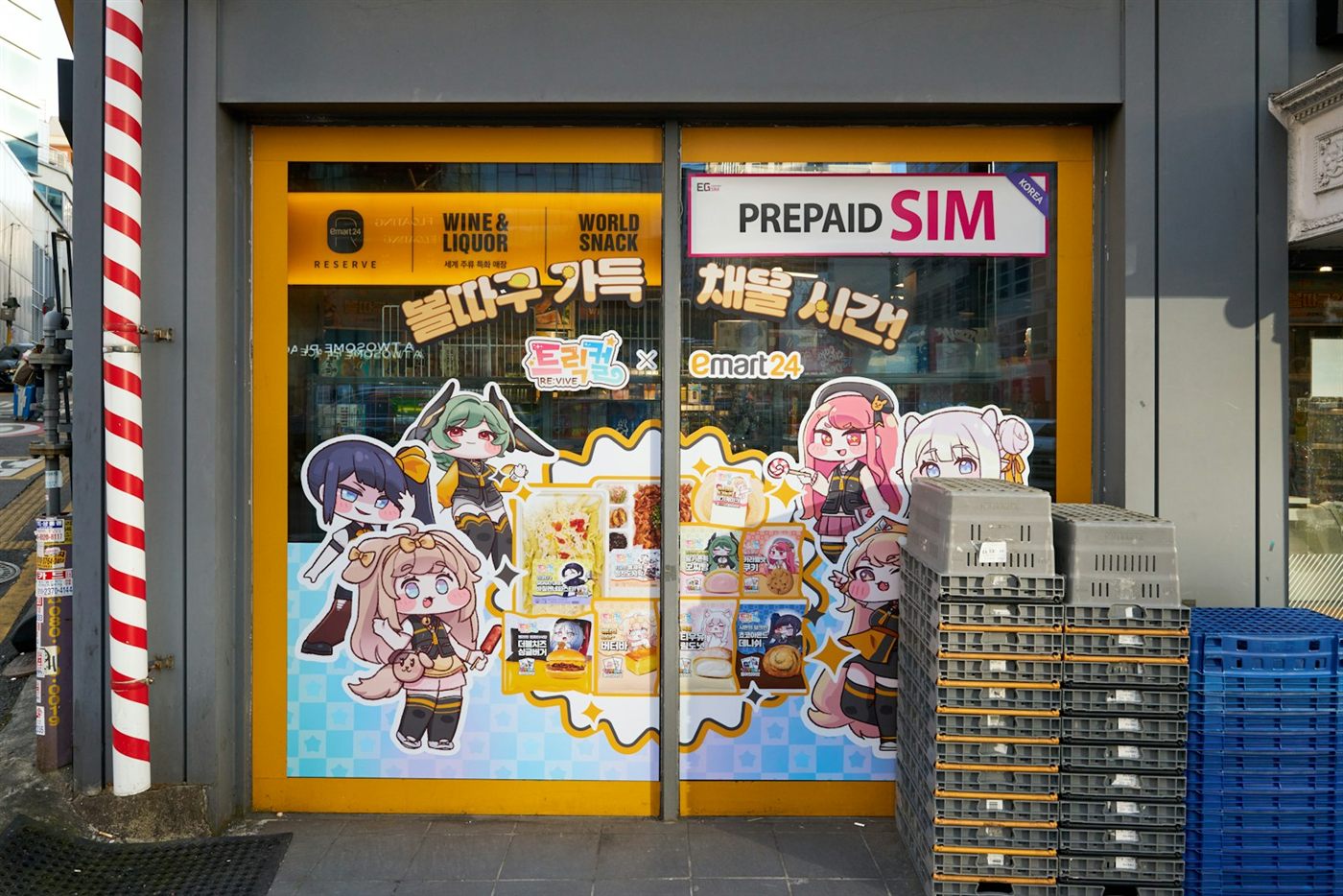
The convenience store and the cafe. In Seoul you will be in a convenience store within hours of arriving: water, snacks, a phone charger, and later your transport card. Shopping at Level 1A works because you can point. 이거 means "this one", 주세요 means "please give me", and 얼마예요? asks the price. At a cafe, put the name of the drink in front of 주세요. To order two things, join them with 하고.
- 이거 주세요.This one, please.1A
- 얼마예요?How much is it?1A
- 커피하고 빵 주세요.A coffee and some bread, please.1A
Put together, a first visit to the counter sounds like this. Every line on both sides stays inside Level 1A.
- 안녕하세요.Hello.
- 안녕하세요. 물 있어요?Hello. Do you have water?
- 네, 있어요. 여기요.Yes, we do. Here.
- 이거하고 이거 주세요.This one and this one, please.
- 네. 감사합니다.Sure. Thank you.
The cashier will often ask you a quick question you will not catch, usually about a bag or a receipt. If you do not need anything else, 괜찮아요 ("I'm fine", "no, thank you") is a polite answer that closes the question. N 주세요 is the most useful pattern of the whole week, and it has its own page with more examples.
- The N 주세요 grammar page on haeyokorean.com, scrolled on a phone.
The transport card at the subway. Seoul's subway and buses run on a rechargeable transport card, the T-money card. It is sold at convenience stores, so this is a shop conversation again: ask if they have one, then ask for one. You can add money to it at the convenience store counter or at machines in the stations. Many of those machines take cash only, so it is worth knowing how to say what you have and what you do not have.
- 현금 없어요. 카드 있어요.I don't have cash. I have a card.1A
있어요 and 없어요 are the same words for "there is / there isn't" and "I have / I don't have". Lesson 4 of Level 1A teaches them together with 주세요, so the shop, the cafe and the subway counter all come from one lesson: Lesson 4, What is this?.
The first class and getting help
The first class and your self-introduction. University language institutes usually start with a placement test, and the first class of any course in Seoul almost always starts with everyone introducing themselves. A short introduction has three parts: your name, where you are from, and that you are a student. After a name or a noun that ends in a consonant, use 이에요; after a vowel, use 예요.
- 안녕하세요. 저는 안나예요. 미국 사람이에요.Hello. I'm Anna. I'm American.1A
- 만나서 반갑습니다.Nice to meet you.1A
만나서 반갑습니다 ends in the formal -(스)ㅂ니다 form, which suits a first meeting in front of a class. If someone guesses wrong about you, correct them with 아니요 and the right noun. All of this, including the formal 입니다 version you will hear in orientation speeches, is the content of Lesson 3, I am a student.
When you are lost or need help. Seoul's campuses and subway stations are large, and in the first week everyone gets lost at least once. You do not need directions in Korean yet. You need one question that gets someone to point. Start with 죄송합니다 to stop the person politely, then name the place and add 어디예요?
- 죄송합니다. 은행이 어디예요?Excuse me. Where is the bank?1A
The answer may be longer than you can follow. Watch the hand, say 감사합니다, and walk in that direction. If you have the name of the building on your phone, show it and say 여기 어디예요? while pointing at the screen.
What we see in the first week
New exchange students who come to us in their first week in Seoul usually know 안녕하세요 and 감사합니다 already, and those two go fine. What stops them is the first question that comes back, at the counter or the housing office. They freeze because they have no sentence ready. So we tell them to carry one fixed answer sentence for each place and to say it even when they are not sure what was asked: 괜찮아요 at the till, 저는 학생이에요 at the office, 죄송합니다 when nothing makes sense. Staff in Seoul switch to short Korean or to English quickly when they see you are new, and that is fine. You still started the conversation in Korean.
We should be honest about our own pages here. Lessons 3 and 4 of Level 1A give you these sentences and a short practice. They do not replace a week of walking around Seoul and using them.
Say this, it means, when
| Say this | It means | When |
|---|---|---|
| 안녕하세요 | Hello | Every office, shop and classroom, to anyone who is not a close friend |
| 감사합니다 | Thank you | When you leave the counter or someone has helped you |
| 죄송합니다 | Sorry / Excuse me | When you do not understand, or before you ask a stranger something |
| 잠깐만요 | Just a moment, please | While you look for your passport, card or phone |
| 이거 주세요 | This one, please | Pointing at something in a shop or on a menu |
| 얼마예요? | How much is it? | Before you pay |
| 있어요? / 없어요 | Do you have it? / I don't have it | Asking for an item, saying you have no cash |
| 어디예요? | Where is it? | After the name of a place, when you are lost |
| 저는 학생이에요 | I'm a student | At the housing office and in your first class |
| 괜찮아요 | I'm fine / No, thank you | When you are offered something you do not need |
The common mistake: 네 to a negative question
In English, if someone asks "You don't have cash?", you answer "No" when you do not have any. In Korean, 네 means "that's right", so it agrees with the question as it was asked. If the question is negative and the negative is true, the answer is 네.
- 현금 없어요? — 네, 없어요.You don't have cash? — Right, I don't.1A
Answering 아니요, 없어요 here sends a mixed message: 아니요 says "that's wrong" and 없어요 says "I don't have any". Staff will usually understand from the second word, but it slows things down at exactly the moments when a queue is waiting behind you. Listen for 없어요? or 아니에요? at the end of a question, and let 네 mean "yes, what you said is true".
Questions people ask
Can I get through the first week in Seoul in English? Many people in Seoul will try to help in English, especially near universities. The trouble is that the conversations you meet first, at the housing office, the convenience store counter and the station machine, are short and fast, and they go more smoothly when you start them in Korean. Ten phrases are enough to start them.
Should I learn Hangul before I arrive? Yes. Every phrase on this page is written in Hangul, and so are the signs, menus and station names you will be reading in your first week. Reading it slowly is enough at the start, and it makes everything else on this list easier to remember.
What should I study after the first week? The phrases above come from the first lessons of Level 1A: introducing yourself, saying what you have and asking for things. The next step is the same course in order, so the placement test in Seoul finds you a little further along. Our classes are taught live from Seoul, near Ewha station, and the first meeting is free.