Use -아요/어요 for almost everything you say in Korea: to your teacher, to shop staff, to a new acquaintance, to a colleague. Use -(스)ㅂ니다 only for a few formal moments, a self-introduction in front of a group, a presentation, a fixed phrase like 감사합니다, and learn to recognise it everywhere else, because it is the ending of announcements, the news and signs.
Both endings are polite. The difference is not respect but setting: -아요/어요 is a conversation, -(스)ㅂ니다 is a microphone. Once you hear it that way, the choice in any given place in Seoul is usually obvious.
Where you hear each ending in Seoul
Here is a day in the city, sorted by which ending comes at you and which one you should send back.
| Where | What you hear | What you say |
|---|---|---|
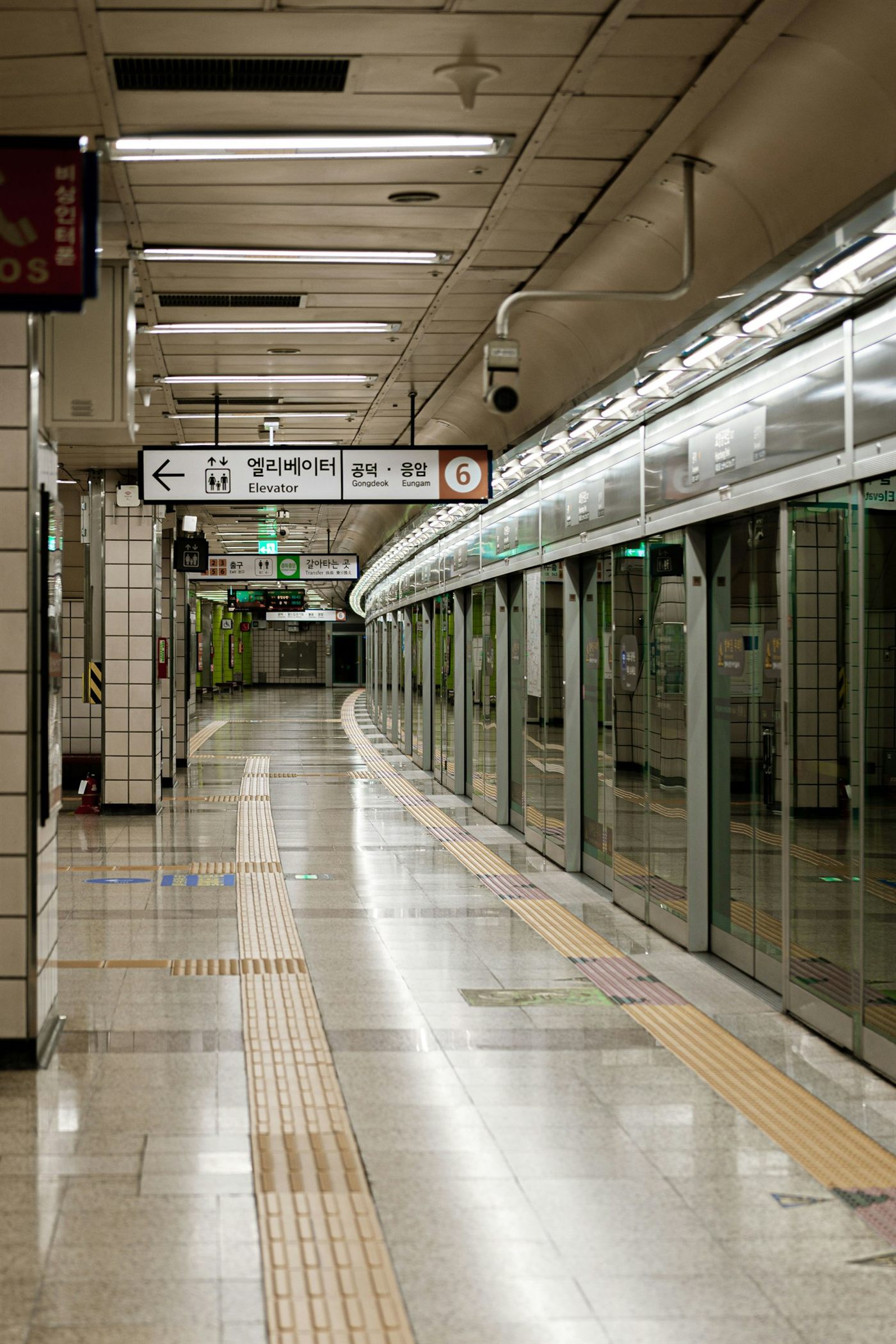
| Subway, bus, airport announcements | -(스)ㅂ니다 | nothing, you listen |
| Television news, a speech, a ceremony | -(스)ㅂ니다 | nothing, you listen |
| A shop, a cafe, a taxi | -아요/어요, with -(스)ㅂ니다 in set phrases like 감사합니다 | -아요/어요 |
| Your Korean class | -아요/어요 | -아요/어요 |
| Introducing yourself to a group, a job interview, a presentation | -(스)ㅂ니다 | -(스)ㅂ니다 |
| Greeting and thanking anyone | fixed phrases | 안녕하세요 · 감사합니다 · 죄송합니다 |
Two things stand out. First, in most of the places where you hear -(스)ㅂ니다, nobody expects you to answer in it. The announcement does not want a reply, and the shop assistant who says 감사합니다 is using a fixed phrase, not switching the whole conversation to the formal style. Second, the one place where you must produce it yourself is the self-introduction, and that is why Level 1A teaches 입니다 in lesson 3, before almost anything else.
- 저는 마크입니다. 학생입니다.I'm Mark. I'm a student.1A
- 처음 뵙겠습니다. 만나서 반갑습니다.How do you do. Nice to meet you.1A
- 저는 마크예요. 학생이에요.I'm Mark. I'm a student.1A
- 감사합니다. — 네, 안녕히 가세요.Thank you. — Yes, goodbye.1A
The first and third lines mean exactly the same thing. The first is what you say when you stand up in front of a class; the third is what you say to the person sitting next to you a minute later.
The three moments to use -(스)ㅂ니다 yourself
A self-introduction in front of people. The first day of a class, a club, a new job, a language exchange with a dozen people in the room. Three or four sentences in 입니다 and -(스)ㅂ니다, then you sit down, and from that moment everything else is -아요/어요. Koreans do the same.
Fixed phrases. 감사합니다, 죄송합니다, 처음 뵙겠습니다, 잘 부탁합니다. These are so common that nobody hears them as formal any more; they are simply the words. They sit happily inside an -아요/어요 conversation, and you will hear 감사합니다 and 고마워요 from the same person on the same day.
Anything with a microphone or a slide. A presentation at school or work, a toast, a speech at a wedding, an interview. If you are the only person talking and others are listening, the formal style is expected.
- 안녕하세요.Hello.
- 저는 안나입니다.I'm Anna.
- 미국 사람입니다.I'm American.
- 대학생입니다.I'm a university student.
- 잘 부탁합니다.Please look after me.
Notice that the greeting stays 안녕하세요 even in a formal introduction. There is a formal version, 안녕하십니까, and you will hear it from a newsreader, but for a learner 안녕하세요 is right in every setting.
How to make each ending
-아요/어요 is the one you will use thousands of times, so it comes first in practice. Take 다 off the verb and look at the last vowel: ㅏ or ㅗ takes 아요, any other vowel takes 어요, and every 하다 verb becomes 해요. A statement and a question have the same form, only your voice changes.
-(스)ㅂ니다 is more regular, which is why it feels easy on paper. Take 다 off: after a 받침 add 습니다, after a vowel add ㅂ니다, and a stem ending in ㄹ drops the ㄹ before ㅂ니다. The question is 습니까? or ㅂ니까?. After a noun there is no 받침 choice at all: 학생입니다 and 의사입니다 both take 입니다, and the question is 입니까?.
- 오늘은 춥습니다.It is cold today.1A
- 비가 옵니다.It is raining.1A
- 학교에 갑니다.I go to school.1A
- 뉴스를 봅니다.I watch the news.1A
- 회사원입니까? — 네, 회사원입니다.Are you an office worker? — Yes, I am.1A
- 학교에 가요. I go to school.
- 학교에 갑니다. I go to school.
- 춥습니다. It is cold.
- 학생입니다. I am a student.
- 저는 유나입니다. 한국 사람입니다. 잘 부탁합니다.I'm Yuna. I'm Korean. Please look after me.
- 저는 마크입니다. 미국 사람입니다.I'm Mark. I'm American.
- 마크 씨, 커피 마셔요?Mark, do you drink coffee?
- 네, 마셔요. 같이 가요.Yes, I do. Let's go together.
- The grammar page for the formal style read on a phone: no 받침 choice, the question 입니까?, and the note that in class we keep talking with 이에요/예요.
What we see in class
Our classes in Seoul run in -아요/어요 from the first lesson. Level 1A teaches 입니다 in lesson 3, next to 이에요/예요, and the verb form -(스)ㅂ니다 in lesson 11, after -아요/어요 in lesson 5, and both formal pages say the same thing: in class we keep talking with the 요 forms, and the formal style is there to recognise and to use for a self-introduction. Students who come to us after learning the formal style first, from a textbook that opens with it because it is regular and easy to drill, tend to have the same two problems. They sound like a news anchor in the convenience store, and when a Korean replies in -아요/어요, as everyone does, they do not recognise the verb they have just used. We spend the first weeks with them undoing the habit rather than adding to it.
The mistake we hear most now is the opposite one, and it comes from dramas set in offices: a student asks a classmate 밥 먹었습니까? and cannot understand why the classmate laughs. The question is grammatical. It is also an interrogation. Between two people in a room, the formal question ending sounds as if one of them is holding a clipboard. The same student usually has no trouble with announcements, because the subway has been training their ear every day.
A smaller habit worth fixing early: answering an -아요/어요 question in -(스)ㅂ니다. 학생이에요? gets 네, 학생이에요, not 네, 학생입니다. Match the ending you were given. The only time you choose the formal style on your own is when you are the one standing up.
Our grammar page for the formal style explains the forms and gives examples; the page for -아요/어요 does the same for the everyday ending. Neither drills you. The practice sets in lessons 3 and 5 of Level 1A do, and the self-introduction in lesson 3 is worth doing out loud until it needs no thought, because it is the one piece of formal Korean you will perform in public.
Questions people ask
Is -(스)ㅂ니다 more polite than -아요/어요?
No. Both are polite; neither is rude in any situation. The formal style is more official and more distant, which is why it fits a speech and sounds odd across a cafe table. If you want to be safe with a stranger, -아요/어요 is already safe.
Do I need -(스)ㅂ니다 at all if I only want to talk to people?
Yes, for two reasons. You will hear it constantly, in every announcement, every news item and most signs, and understanding it is listening, not speaking. And sooner or later someone will ask you to introduce yourself to a group, and that is a moment to have ready.
Which one does my textbook or the TOPIK use?
Textbooks differ: some open with the formal style, some with -아요/어요. Our course teaches 입니다 in lesson 3 for the self-introduction, -아요/어요 in lesson 5 for everything else, and the verb form -(스)ㅂ니다 in lesson 11. Formal written Korean, such as a report or an essay, generally uses -(스)ㅂ니다 or the plain written style rather than -아요/어요, so you will meet it again when you start writing at length.