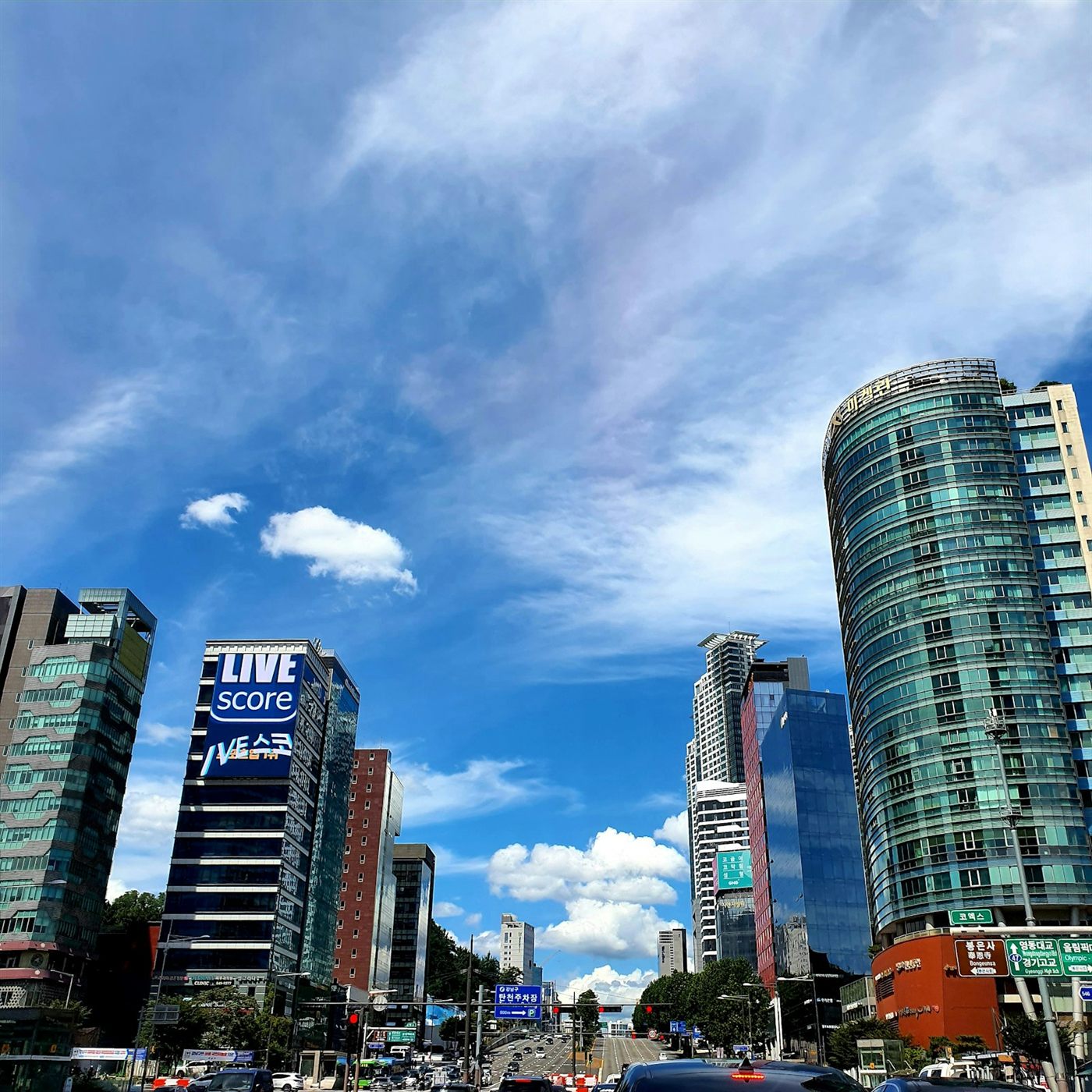
Stand near a Gangnam Station exit at nine in the morning and the street does the explaining for you. A stream of people in lanyards and office shoes leaves the stairs, splits at the crossing and disappears into lobbies that all look the same from the pavement. Each of them walked into a company at some point, through some door: a posting, a friend, a campus fair, a recruiter's message. If you are not Korean, you are probably asking which door is yours.
We cannot give you one door. What we can do is tell you what the official numbers say about foreign workers as a whole, then sort the rest into what is reported and what people merely say. Where we found no source, we leave the gap visible instead of filling it. That is the rule for this whole issue, and this story needs it more than most, because job advice online is full of confident numbers with no origin. Near the end we list everything we looked for and could not confirm, so you know where the ground is firm and where it is not.
The crowd in numbers
Start with the people who already have jobs. Statistics Korea's 2025 survey counts 1.692 million foreign residents aged 15 and over. Their employment rate is 65.5 percent and their unemployment rate is 6.4 percent. Both figures come from the statistics agency's own release, which we read, so we mark them official.
A second number, from the May 2025 survey as reported in the press, puts employed foreigners at 1.109 million. Students and workers on the non-professional visa (E-9 and similar) were the two largest contributors to that year's increase, which is a reminder of who the typical foreign worker in Korea is. It is not the person in the lanyard. Among foreign employees paid a wage, 50.2 percent earned between two and three million won a month and 36.9 percent earned more than three million. Among workers on professional visas, 50.8 percent earned more than three million. The wage figures are a press report of the survey, so treat them as a rough shape and not a salary guide.
The typical foreign worker in Korea is not the person in the lanyard.
Where foreigners actually get hired
There are two different labour markets hiding behind the word foreigner. One is the large market for factory, farm, construction and service work that runs through its own visas and employer permits. The other is the market for office, technical and research jobs that most readers of this magazine are thinking about. The rest of this story is about the second one, so keep in mind that it is the smaller door.
For that second market, the clearest picture we found comes from a commercial guide site, which we label community. It says foreign hiring is visible at large-company research teams in semiconductors, batteries and AI, at IT companies, at startups, and in doctoral-level research. For education, it notes that English-teaching postings are plentiful and that engineering postings get buried among them. That is a description of what a jobseeker will see on a screen, not a count of how many foreigners each sector employs.
We found nothing sourceable on trading companies or on hotels and restaurants, so we say nothing about them. If you work in those fields and want to tell us what you saw, that is exactly the kind of report we would add to a later issue, labelled as one person's account.

One more data point belongs here because it frames everything else. Of international students who graduated in 2024, 33.4 percent were employed afterwards, up from 21.7 percent the year before, according to a press report of Ministry of Education data. A separate report on a Ministry of Justice analysis from September 2026 says large shares of past entrants left the country: 71.8 percent of bachelor's students, 71.3 percent of master's students and 81.3 percent of doctoral students. We read the press versions only, and another outlet gives a slightly different employment rate, so we do not treat 33.4 as final. The direction is clear anyway: most international graduates do not stay.
How much Korean each kind of employer wants
This is the question we hear most from learners, and the honest answer is that nobody has measured it. What exists is a set of descriptions from the same commercial guide, plus a handful of job postings it links. We label all of it community and ask you to read it as a starting guess.
| Employer type | What the guide says | How far to trust it |
|---|---|---|
| Large conglomerates | Interviews are entirely in Korean. One conglomerate is described as treating TOPIK level 3 as the minimum. A 2024 internship posting from one IT services firm asked international students for TOPIK level 4. | Two examples. Treat as a signal, not a rule. |
| Big IT platforms | Some firms' engineering teams work mainly in English; others use Korean internally. The guide names companies on each side. | Company practice changes. Check the posting. |
| Startups | English first in many teams, but some work, such as one bank's operations, runs in Korean. | Varies team by team. |
| Postings written only in Korean | The guide reads this as a sign the work itself is in Korean, and describes a working level as roughly TOPIK 4. | The guide's interpretation, not a standard. |
All rows from one commercial guide. The guide also notes that TOPIK does not test speaking. We could not find a source that measures expected Korean level by sector.
Two cautions. First, the E-7 work visa does not generally require Korean, but sources disagree: some say TOPIK 3 or 4 helps. We could not settle it, so we leave it unverified. Second, the TOPIK number on a posting and the Korean you need in a Tuesday meeting are different things. A posting may say level 3 while the meeting runs at a speed that feels like level 5. That is a lesson from teaching, not a statistic, but we say it because it is the gap learners fall into.
What this means for study: if your target is a Korean-language office, level 3 is where you can start applying and level 4 is where interviews stop being a fight. If your target is an English-first team, Korean still decides how you eat lunch and who explains the unwritten rules. Treat it as a way into the room, not a box to tick.

Where the postings are
Job boards are the front door that everyone can see. The table below comes from a guide site that also promotes its own service, so we label it community and keep to the plain facts.
| Site | What it is for |
|---|---|
| Saramin, JobKorea | Korean-language boards with the most postings. |
| Wanted | Korean and English interface, strong on tech and startups; many postings show a salary band. |
| Multinational and English-language roles. | |
| PeoplenJob | Foreign-owned companies. |
| Work24 (고용24) | The government employment portal. |
| KOWORK | A board with visa filters. |
One service in the guide, KLiK, is reported closed on 8 June 2026. We could not check Contact Korea (KOTRA) directly, so we do not describe it.
There is also an in-person route. The Seoul Global Center is listed as the organiser of a 2026 Seoul foreign jobseeker fair on 18 November at SETEC with 100 selected companies. We saw this on a student-activity listing and not on the organiser's own page, so check the date before you travel.
A practical way to use these boards is to search the same job title in two places and compare. A posting written only in Korean on a Korean-language board and the same role on an English-friendly board can ask for quite different things, and the difference tells you something about whom the company expects to hire. We offer that as a habit from teaching, not as research. What we can add from the sources is the order of preference the hiring survey reports: job-related experience first, so an internship or a project you can describe in Korean counts for more than a general statement of interest.
Experience raises one more awkward point for students. A foreign graduate who has worked part-time may have hours in cafes and shops, which are legal and honest work but rarely the job-related experience a firm means. If you can, spend one term on something close to the field you want, such as a lab project, a company internship that the visa allows, or a freelance task you can show. Check the part-time and internship rules for your visa in our working-while-studying story before you accept anything.
The cover letter, and why it is fading
For years the Korean 자기소개서 (self-introduction letter) was the heart of a large-company application: why you applied, how you grew up, what you did at school. It still appears. Listings gathered for the big public hiring seasons still ask about motivation and background. But the ground is moving.
A September 2026 survey by the career site Jinhaksa Catch asked 1,008 jobseekers about dropping the letter. 58 percent were positive, 13 percent negative, and 93 percent said they had used AI to write one. The same report notes that one large chip maker dropped the letter for its second-half hiring in favour of a half-day interview, one steelmaker asks about school and outside activities instead, and one bank uses a video interview. It is a private survey of jobseekers, not of employers, so it tells you what applicants feel and what a few firms did.
If you do write one, the practical point is the same as for any text in a second language: have a Korean speaker read it for natural phrasing, not for content. The survey number on AI use is worth a second thought, because a letter that reads as machine-smooth may be exactly what the reader has seen two hundred times that week. We offer that as a reading of the survey, not a finding.
Interviews: what we can and cannot say
We found no survey that measures interview norms for foreigners: what to wear, how to bow, how a panel treats a non-native speaker. Many online lists exist, and almost none say where their numbers come from. We chose not to repeat them. What we can say comes from the hiring surveys here and from the logic of the process: large firms increasingly use short, structured interviews, and the more a firm hires through open recruitment the more standard its steps become. Smaller firms interview in whatever way the hiring manager prefers.
If you want a safe order of preparation, here is ours. Prepare a clear Korean answer to why you want this job and why in Korea. Practise it aloud until it survives follow-up questions. Prepare one example of work you did with other people. That is advice from teaching experience, and it rests on the one finding we can source: employers rank job-related experience first when hiring new staff (see below).

Hiring seasons
Traditionally, large Korean companies hired new graduates twice a year in fixed open-recruitment seasons, one in the first half and one in the second. That pattern is weakening. In the Korea Enterprises Federation's 2026 survey of 500 firms with more than 100 employees, 54.8 percent said they hire only on a rolling basis, 35.0 percent combine rolling and open recruitment, and only 10.2 percent hire through open recruitment alone. A year earlier, the rolling-only share was 70.8 percent and the combined share 22.6 percent. The same survey says 66.6 percent of firms planned to hire new staff this year and that 67.6 percent rate job-related experience as the top factor.
For the second half of 2026, a Federation of Korean Industries survey of 121 large firms found 51.2 percent planning to hire, 14.0 points more than the year before. Of those, 54.9 percent will combine both methods, 30.6 percent will use open recruitment only and 14.5 percent rolling only. These surveys have different samples and dates, so please do not compare one with the other. Each firm's own site is the only place to see its dates, and we found no source that lists the months.
What this means for a foreign applicant is our reading, not a finding: with rolling hiring, a posting can appear at any time and close when it is filled, so a calendar matters less than being ready. Having your documents, a polished résumé and a basic Korean self-introduction prepared before a posting appears is worth more than any calendar.
The sponsor problem
For a job that needs a work visa, a company has to hire you before the immigration office will approve you, and in practice the company runs the application. A visa guide says an individual cannot apply alone for E-7. A Korean education researcher quoted in a press report in August 2026 says firms are reluctant, because hiring foreigners brings administrative work and they do it only for people they truly need. We have heard the same in conversations with learners, but we have no number for how many firms refuse.
The question that comes up next is salary. A visa agent's blog, quoting a Ministry of Justice notice we could not open, says the pay floor for the standard professional E-7-1 visa from 1 February to 31 December 2026 is 31.12 million won a year before tax. It gives 25.89 million for E-7-2 and E-7-3 and 26.0 million for E-7-4. The 2025 floor of 28.67 million won is on an official ministry page, though we read the amount in private summaries and not in the file. Earlier, the rule tied the floor to the national income average (GNI) per person, with a lower percentage for small firms; the guide sources say that method ended in April 2025 and one figure now applies to firms of any size. This is community-level information with one official anchor, so call the immigration information line, 1345, before you plan around the number.
Those blogs add one practical warning: a tax-free meal allowance was not counted toward the salary requirement in a case the agent describes, so how your contract splits pay into items matters. We cover how a contract is built in the companion story on reading an employment contract.
- 1,528 to 3,090
- approved changes of status from D-10 (job seeking) to E-7, 2021 to 2025, reported with an approval rate around 90 percent each year
- 499 to 599
- direct changes from D-2 (degree student) to E-7 over the same years, far fewer
- 3,112만원
- E-7-1 yearly pay floor in 2026, per a visa agent citing the notice; confirm with 1345
The two conversion numbers tell a story we find useful. In 2025 about 3,100 people went from the job-seeking visa to a work visa, roughly twice as many as in 2021, and by our arithmetic about five times as many as went straight from a degree. Most graduates therefore pass through D-10 first. The same press report says screening looks at whether your field and experience fit the job and whether the hiring company is in good standing on taxes and employment insurance, which is a community-level reading of how decisions are made.
Pay: what we can and cannot tell you
Readers always ask what a foreign new graduate earns in a given sector. We have no sourced figure for that, and we found tables online that cite nothing. We will not print them. Here is a way to think about it that rests only on what we can source.
| What you can use | What it is | Caution |
|---|---|---|
| E-7 pay floor | A legal minimum for the visa, not typical pay (see above) | Community-level source for the 2026 amounts |
| Desired starting pay, JobKorea survey | Average 36.1 million won a year for new graduates; large firms 43.0, mid-size 35.2, small 30.7 million | What applicants want, not what is paid; survey year to be confirmed |
| Foreign employees' pay, May 2025 | Half of wage earners made two to three million won a month | Press report; all foreign workers, not new graduates |
We found no sourced pay for foreign new graduates by industry. A large firm usually pays more than a small one; beyond that, we describe ranges only in words.
In plain words: pay depends strongly on the size of the firm, and the survey above shows large firms at the top and small firms at the bottom. Some foreign-owned companies and startups publish salary bands in their postings, and the board Wanted is described as showing them often. That is the nearest thing to real data you can gather yourself, and it takes five minutes per posting.
A short plan
Before you apply
Decide whether your target is a Korean-language or English-first team, and be honest about the level of Korean you can show today. Prepare a Korean résumé and a short spoken self-introduction.
While you apply
Use one Korean-language board and one English-friendly board. Read each posting's visa line. Ask early whether the company has hired a foreigner before and who handles the paperwork.
Before you sign
Read the contract line by line against our companion story, check the salary against the visa rule, and call 1345 for the visa questions only the immigration office can answer.
Back to the crowd at the station exit. Every person in it got in through some door, and the doors are more varied and more crowded than the street suggests. The honest news is that the biggest door for a foreigner is neither the largest company nor the best posting. It is a firm that wants you enough to do the paperwork. Find that firm, and keep learning Korean while you look, because when two applicants are close, the one who can talk to the team usually has the edge. That last line is our teaching opinion, not a statistic.