은/는 marks the topic, the thing the sentence is about, often something already known, and it is also how Korean shows contrast ("this one, as opposed to that one"). 이/가 marks new information: the person or thing that fills the gap, which is why the answer to "who?" or "what?" takes 이/가.
Both particles sit right after a noun, and both have two shapes depending on whether that noun ends in a consonant (a 받침) or a vowel. That part is mechanical. The harder part is choosing between them, and that is what most of this guide is about.
The short version
Here is the whole system on one table. The 받침 check is the same one you already use for 이에요/예요.
| After a consonant (받침) | After a vowel | What it marks | |
|---|---|---|---|
| 은/는 | 은 — 선생님은 | 는 — 저는 | The topic: what the sentence is about, something already known, or one side of a contrast |
| 이/가 | 이 — 책이 | 가 — 의자가 | New information: who or what, the answer to a question, what exists or is missing |
A few fixed habits come with these particles from the very first lessons:
- A name with 씨 always takes 는 or 가, because 씨 ends in a vowel: 민수 씨는, 민수 씨가.
- Before 있어요 and 없어요, the thing that exists or is missing takes 이/가: 책이 있어요.
- Before 아니에요, the noun takes 이/가, never 은/는: 학생이 아니에요.
- 누구 ("who") plus 가 becomes 누가.
- 저는 학생이에요.I am a student. (As for me, I'm a student.)1A
- 선생님은 한국 사람이에요.The teacher is Korean.1A
- 책이 있어요.There is a book. / I have a book.1A
- 아니요, 학생이 아니에요. 선생님이에요.No, I'm not a student. I'm a teacher.1A
New information or a known topic
Think of a conversation as a stage. 은/는 points at something that is already on the stage, or that you are putting there as the subject of what comes next. 이/가 brings something new onto the stage, or picks out which one.
That is why a self-introduction starts with 저는. You are not telling anyone that a person exists; you are saying "as for me" and then adding the new part, 학생이에요. The new part comes after the topic, in the ending.
이/가 works the other way round. The new part is the noun itself. When you say 책이 있어요, the news is the book: there is one. When you ask 뭐가 있어요?, you are asking which thing fills the gap, and the answer takes 이/가 as well.
- 저는 학생이에요.I am a student.
- 책이 있어요.There is a book.
- 민수 씨가 와요.Minsu is coming.
- 커피는 있어요.There's coffee.
The answer-to-a-question test. The quickest way to check your choice is to imagine the question your sentence answers.
If the question is "who?" or "what?", the word that answers it takes 이/가. 누가 와요? asks who is coming, so the answer is 민수 씨가 와요, not 민수 씨는 와요. Answering with 은/는 here sounds as if you are changing the subject to Minsu rather than answering.
If the question is about someone already named, the name is the topic and takes 은/는. 민수 씨는 학생이에요? asks about Minsu, so the answer keeps him as the topic: 네, 민수 씨는 학생이에요.
- 누가 와요? — 민수 씨가 와요.Who is coming? — Minsu is coming.1A
- 누가 학생이에요? — 민수 씨가 학생이에요.Who is the student? — Minsu is the student.1A
- 뭐가 있어요? — 책하고 공책이 있어요.What is there? — There's a book and a notebook.1A
Notice the last one. With two nouns joined by 하고, 이/가 goes after the last noun only.
Contrast: the other job of 은/는
은/는 has a second use that matters even more in everyday speech: it sets one thing against another. When two sentences side by side both use 은/는, Korean listeners hear "this one ... but that one ...".
You meet this as early as introducing two people: 저는 학생이에요. 민수 씨는 선생님이에요. Each person is a topic, and the pair reads as a contrast: I am a student; Minsu, on the other hand, is a teacher.
It is the same with things. Saying what you have and what you don't is a natural place for contrast, so 있어요 and 없어요, which normally take 이/가, switch to 은/는 when you are comparing two items.
- 저는 학생이에요. 민수 씨는 선생님이에요.I'm a student. Minsu is a teacher.1A
- 커피는 있어요. 그런데 물은 없어요.There's coffee. But there's no water.1A
- 이것은 책이에요. 저것은 공책이에요.This is a book. That one over there is a notebook.1A
Compare 커피가 있어요, which simply reports that there is coffee, with 커피는 있어요, which carries an unspoken "but something else is missing". Even with nothing after it, a Korean listener waits for the other half.
- The grammar page for 은/는 read on a phone: the two forms, the key points, example sentences and the textbooks that teach it.
The mistake teachers actually see
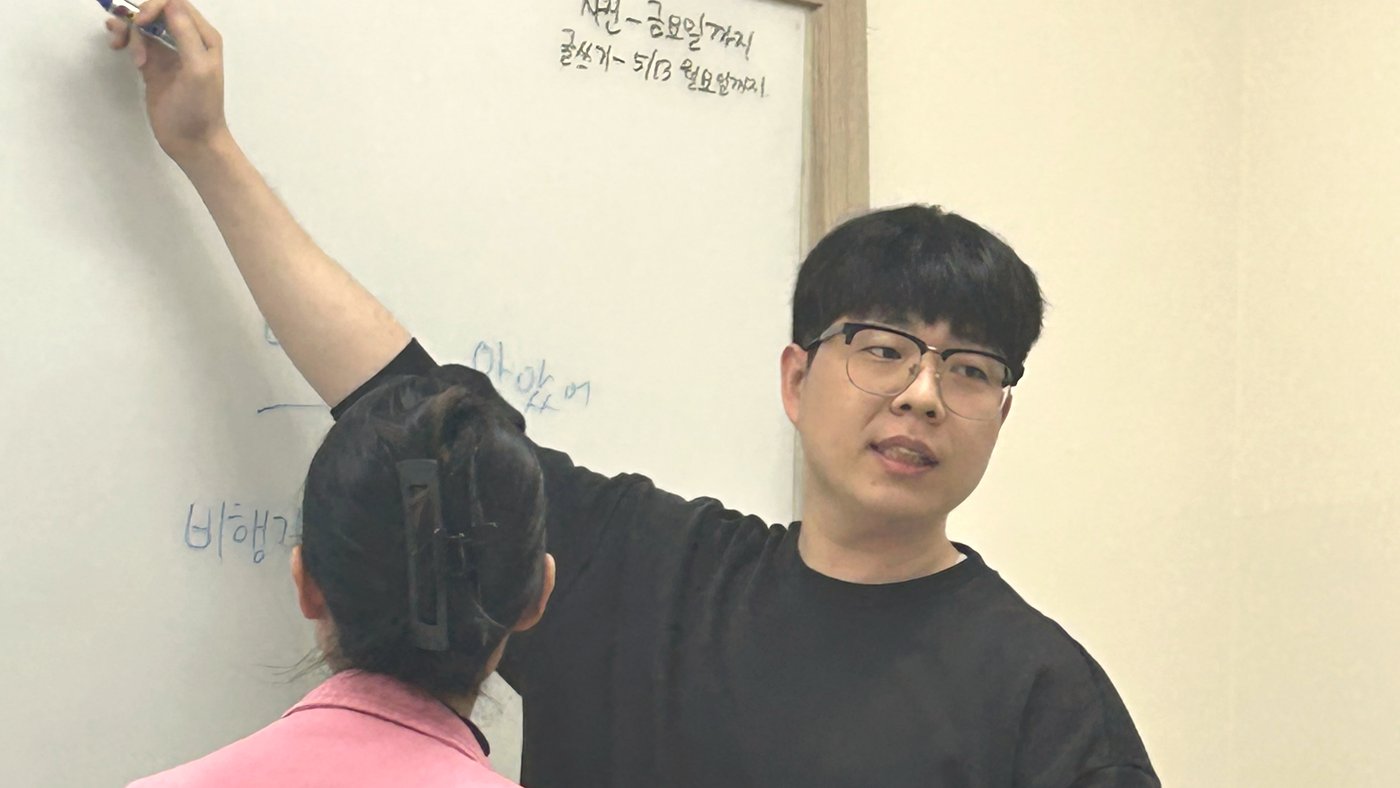
Learners are often warned about mixing up 은/는 and 이/가, and they do. But in our classrooms in Seoul, the more common mistake is something else: leaving both particles out.
A beginner says 저 학생이에요 or 책 있어요 and moves on. It is understandable. Korean speakers do drop particles in short, relaxed speech, and learners hear that. The trouble is that when you drop them everywhere, you also drop the information they carry. Your listener can no longer tell what is new, what is the topic, and whether you meant a contrast. In a short sentence that is fine; in a conversation of several sentences, it makes you harder to follow. Keep the particles while you are learning, in speaking and in writing. You can start dropping them later, once you know what you are leaving out.
The second mistake is using 이/가 where a contrast is meant. Imagine someone asks whether there is coffee and water. A learner answers:
- 커피가 있어요. 물이 없어요. Both sentences are correct on their own, but together they sound like two separate reports, with no link between them.
- 커피는 있어요. 그런데 물은 없어요. This is what a Korean speaker would say. The 은/는 on both nouns tells the listener you are comparing them.
A simple habit helps here: when your sentence has an "and ... but" shape in English, check whether both nouns should take 은/는.
Here is what we do with this in class. We tried teaching the labels on their own, topic and subject, and they did not help much: a student could repeat the rule and still drop both particles in the next sentence. What works better is the question test from earlier. We ask the question out loud, 누가 와요? or 민수 씨는 학생이에요?, and the answer has to come back with its particle. We also ask students to keep every particle while they are learning, even when they hear Koreans drop them outside class.
Our own pages have limits too. The grammar page for 은/는 explains the point and gives examples; it does not drill you. The practice set in lesson 3 of Level 1A does, and it is short, so treat it as a start rather than the whole job.
Questions people ask
Is 은/는 the topic and 이/가 the subject?
That is a useful first label, and many textbooks use it. In practice, the subject of a sentence can take either particle. What decides it is whether the noun is new information or the answer to a question (이/가), or something already known or being contrasted (은/는). The labels help you remember; the question test helps you choose.
Why do I hear 저는 so often but almost never with 이/가?
Because 저 is almost always already on the stage: you are the person speaking. When you introduce yourself, you set yourself up as the topic and add the new part after it. You only need 이/가 with "I" when you are the answer to "who?", and that form changes shape. You will meet it in a later level.
Do I really need particles if Koreans drop them?
Koreans drop them when the meaning is obvious from context. As a learner, you do not yet have a feel for when it is obvious, so keep them. Your Korean will sound clearer, not more stiff, and your teacher can see that you know which one you meant.