Korean has two sets of numbers, and the rule for choosing is shorter than it looks: you count with the native numbers, 하나, 둘, 셋, and you read with the Sino-Korean numbers, 일, 이, 삼. Things, people, cups and hours are counted, so they take 하나, 둘, 셋; dates, minutes, prices, floors, bus lines and phone numbers are read off a sign, a clock or a receipt, so they take 일, 이, 삼.
There is exactly one place where the two sets meet in a single phrase, the time of day, and that is where almost every learner slips. The rest of this guide goes situation by situation through a day in Seoul and shows which set each one takes and why.
One table, from the cafe to the subway
| Situation | Set | You say | Why |
|---|---|---|---|
| Cups, bottles, things | native | 커피 두 잔 · 물 한 병 · 빵 세 개 | you count them |
| People | native | 두 명이에요. | counted |
| Hours | native | 세 시 · 열두 시 | counted on the clock face |
| Minutes | Sino-Korean | 십 분 · 사십오 분 | read off the clock |
| Dates and months | Sino-Korean | 시월 구 일 | read off the calendar |
| Prices | Sino-Korean | 삼천오백 원 · 만 이천 원 | read off the receipt |
| Portions at a restaurant | Sino-Korean | 고기 이 인분 | the one counter that takes Sino-Korean |
| Floors, bus and subway lines, phone numbers | Sino-Korean | 삼 층 · 이 호선 | read off a sign |
| Age | native | 스무 살 (Level 1B) | counted, like years lived |
The pattern behind the table is the one you can actually use at a counter: if you would hold up fingers, use the native numbers; if you would point at a number written somewhere, use the Sino-Korean numbers. Hours break the rule, and that is why they get their own section below.
- 커피 두 잔 주세요.Two coffees, please.1A
- 빵을 세 개 샀어요.I bought three pieces of bread.1A
- 학교에 학생이 다섯 명 있어요.There are five students at school.1A
- 얼마예요? — 삼천오백 원이에요.How much is it? — It's 3,500 won.1A
- 시월 구 일이에요.It's the ninth of October.1A
Counting: native numbers and a counter
When you count, Korean puts the noun first, then the number, then a counter, a small word for the kind of thing you are counting: 커피 두 잔 is coffee, two, cup. The counters you need first are 개 for things in general, 명 for people, 잔 for cups and glasses, 병 for bottles and 권 for books. The first four numbers get shorter in front of a counter: 하나 becomes 한, 둘 becomes 두, 셋 becomes 세, 넷 becomes 네, and 스물 becomes 스무. From 다섯 on nothing changes.
With 주세요 the noun usually carries no particle: 커피 두 잔 주세요. With other verbs the particle stays on the noun and the number and counter sit right before the verb: 빵을 세 개 샀어요. To ask how many, use 몇 plus the counter: 몇 개 있어요? 몇 명이에요?
One restaurant counter goes the other way. 인분, a portion, takes the Sino-Korean numbers: 고기 이 인분 주세요. It is the first exception you will meet and the one you will hear most, because meat in Korea is sold by the portion.
- 2 cups: 커피 두 잔two cups of coffee
- 3 people: 세 명three people
- 3:10: 세 시 십 분ten past three
- ₩3,500: 삼천오백 원three thousand five hundred won
- Oct 9: 시월 구 일the ninth of October
Reading: Sino-Korean numbers for dates, prices and signs
Dates, minutes, prices, floors and anything with a digit printed on it use 일, 이, 삼. Months are the number plus 월, days the number plus 일: 시월 구 일, with the two irregular months 유월 and 시월 for June and October. Prices are built from 십, 백, 천 and 만, and Korean groups by four zeros, so 10,000 is one word, 만, and 12,000 is 만 이천. Never put 일 in front of 십, 백, 천 or 만: 천 원, not 일천 원. The answer to 얼마예요? is the price plus 이에요, and 원 always takes 이에요 because it ends in a 받침.
Signs follow the same logic. The third floor is 삼 층, subway line 2 is 이 호선, bus 143 is read digit by digit or as a number, and a phone number is read one Sino-Korean digit at a time. You do not need to produce most of these in Level 1A, but you need to recognise them, because every lift, platform and receipt in Seoul is talking to you in Sino-Korean numbers.
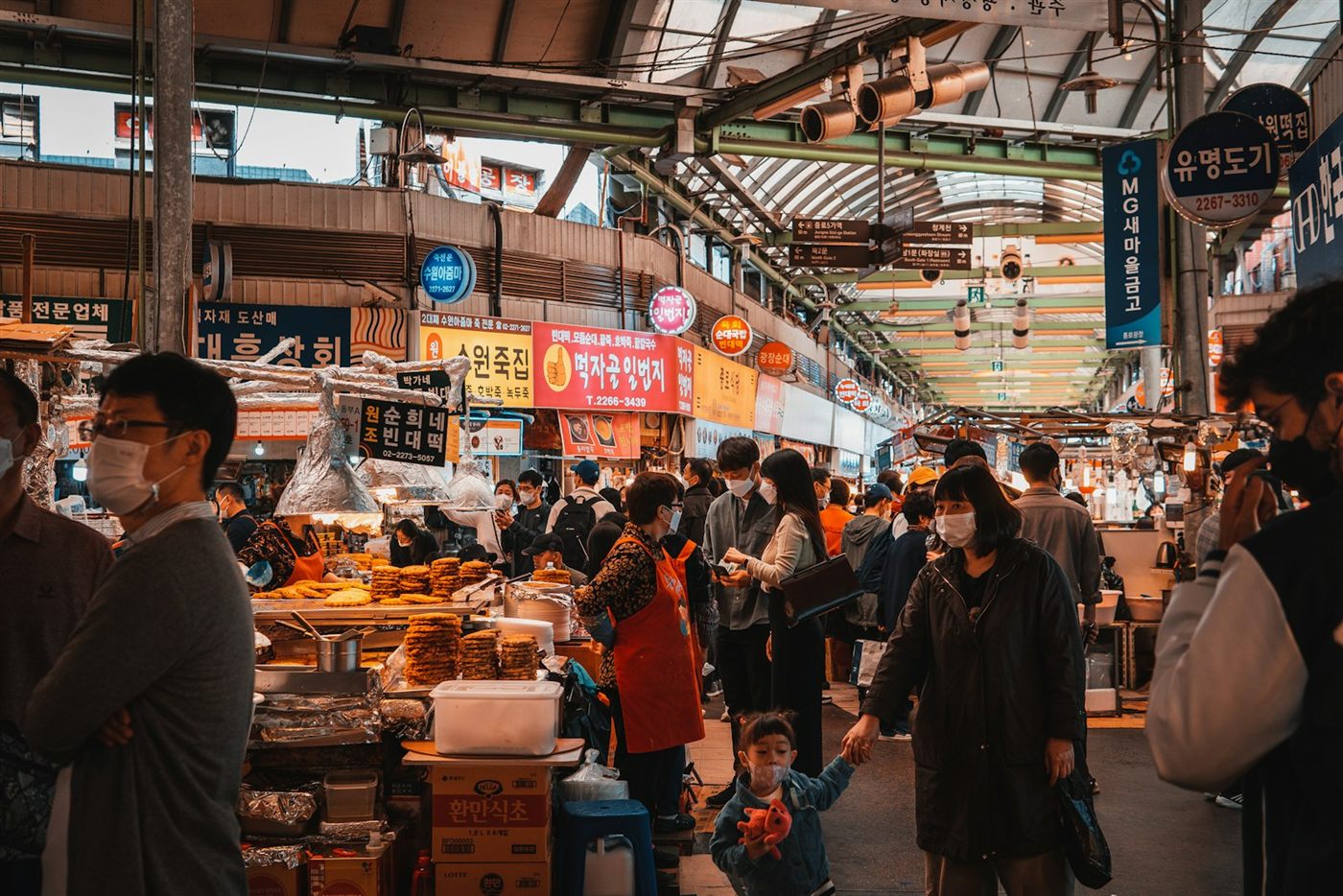
The time of day: where the two sets meet
Hours take the native numbers, with the short forms before 시: 한 시, 두 시, 세 시, 네 시, 다섯 시, up to 열두 시. Minutes take the Sino-Korean numbers: 십 분, 이십 분, 사십오 분. Say the hour first and the minutes after it: 세 시 십 분 is 3:10, and half past is 삼십 분. To say at what time something happens, add 에: 두 시에 만나요. With a day as well, 에 comes once, at the end: 토요일 두 시에.
This is the sentence where the two sets sit side by side, and the mistake we hear most is 삼 시 for three o'clock. It is understandable: the minutes right after it are Sino-Korean, the clock shows a 3, and 삼 is the number the learner has been reading all day. Korean does not accept it. Hours are counted, not read, and the reason is historical rather than logical, so there is nothing to understand, only to practise.
- 몇 시예요? — 세 시 십 분이에요.What time is it? — It's ten past three.1A
- 두 시에 만나요.Let's meet at two.1A
- 토요일 두 시에 영화를 봐요.We're seeing a film on Saturday at two.1A
- 고기 이 인분 주세요.Two portions of meat, please.1A
- 뭐 주세요?What would you like?
- 커피 두 잔 주세요. 얼마예요?Two coffees, please. How much is it?
- 칠천 원이에요.Seven thousand won.
- 네. 몇 시예요?Here you are. What time is it?
- 세 시 십 분이에요.Ten past three.
- The grammar page for counting things read on a phone: noun, native number, counter, the short forms 한 두 세 네, and 인분 as the exception.
What we see in class
Both number sets arrive within three lessons of Level 1A, dates in lesson 7, hours and the native numbers in lesson 8, counters and prices in lesson 9, and for about a month afterwards students mix them. The mistakes are not random. Nobody says 하나 원; prices are read so often that Sino-Korean sticks to them at once. The errors cluster in two places: the hour, 삼 시, and the counter, 삼 개, in both cases Sino-Korean leaking into a slot that counts.
What did not work for us was teaching the sets as two lists to memorise and a table of counters to go with them. Students learned the lists and still reached for the wrong set under pressure, because a list does not tell you which to use. What worked was the single question in this guide, would you hold up fingers or point at a digit, asked out loud every time a number came up in class, for a few weeks. The hour has to be learned as the exception to that question, and we drill it on its own with a clock, hour by hour, until 세 시 comes out without thought.
The other habit worth building early is the short forms. 하나 개 and 둘 명 are the sign of someone who learned the numbers from a list; 한 개 and 두 명 are the sign of someone who learned them in sentences. Say every count with its counter from the first day and the short forms take care of themselves.
Our pages split this topic three ways: the counting page covers the native numbers and the counters, the prices page covers the Sino-Korean numbers and 얼마예요, and the time page covers the one place they meet. Each explains; none drills. The practice sets in lessons 8 and 9 of Level 1A do, and age, 살, comes in lesson 1 of Level 1B, where it follows the same native-number rule.
Questions people ask
Is there a quick way to remember which set hours and minutes take?
Hours are native, minutes are Sino-Korean, and the order in the sentence is hour then minute: 세 시 십 분. Most students remember it as "count the hours, read the minutes". The clock is the one everyday object that makes you do both in a single breath.
Do Koreans ever use Sino-Korean numbers to count things?
Yes, for large counts. Above about twenty, and always above a hundred, Koreans switch to Sino-Korean even with a counter: 백 개, a hundred pieces. For anything you would say at a shop or a table, the native numbers are right, and 인분 is the one small counter that takes Sino-Korean from the start.
How do I say my age?
With the native numbers and 살: 스무 살, 스물세 살. It is taught in lesson 1 of Level 1B, with the family words, and it follows the counting rule because years lived are counted. You will also hear ages in Sino-Korean with 세 in formal and written Korean, but that is for reading, not for introducing yourself.